As the cryptocurrency ecosystem continues to mature, regulatory frameworks play a pivotal role in shaping innovation, investment, and adoption. With TOKEN2049 Singapore on the horizon, understanding how Singapore’s approach stacks up against other global hubs is essential for industry participants. This event, a premier gathering for blockchain leaders, offers a timely backdrop to explore these differences. Singapore has long positioned itself as Asia’s crypto powerhouse, but how does it compare to the United States, European Union, United Arab Emirates, and Hong Kong? This article delves into the nuances, highlighting strengths and challenges as of early 2026.
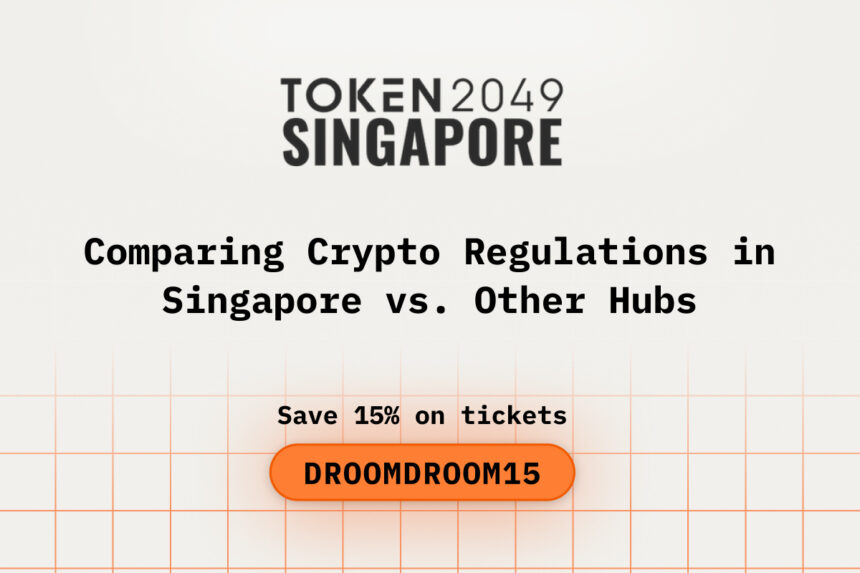
Use the official TOKEN2049 promo code DROOMDROOM15 to get 15% off your ticket today.
Singapore’s Regulatory Landscape
Singapore’s crypto regulations are overseen by the Monetary Authority of Singapore (MAS), which adopts a risk-based and innovation-friendly stance. This framework emphasizes consumer protection while fostering growth.
Key Features
The MAS requires licensing for digital payment token services, including exchanges and custodians, under the Payment Services Act. Stablecoins are tightly regulated since 2023, mandating 100% reserve backing in cash or equivalents, segregated assets, and monthly attestations. Issuers need a Major Payment Institution license for volumes exceeding 5 million SGD.


Taxation is favorable: no capital gains on long-term holdings, making it attractive for investors. Anti-money laundering (AML) rules align with global standards, requiring robust KYC processes. This clarity has licensed over 30 entities by 2025, positioning Singapore as a hub for institutional activity.
Don’t miss out on TOKEN2049 – apply the promo code DROOMDROOM15 for a 15% discount on tickets.
Comparison with the United States
The U.S. has made strides with the GENIUS Act of 2025, creating a federal stablecoin framework that demands full reserve backing, licensed issuers, and redemption at par. Unlike Singapore’s streamlined licensing, U.S. regulations are complex, involving multiple agencies like the SEC and CFTC. The proposed Clarity Act aims to clarify market structures, but implementation lags behind Singapore’s established rules. Taxation includes capital gains, contrasting Singapore’s exemptions. While the U.S. offers massive market scale, its fragmented approach can deter smaller players, whereas Singapore’s MAS provides quicker pathways for compliant innovation.
Comparison with the European Union
The EU’s Markets in Crypto-Assets (MiCA) regulation, fully effective in 2025, harmonizes rules across 27 member states, classifying stablecoins as Electronic Money Tokens or Asset-Referenced Tokens with strict reserve requirements. This passporting system allows seamless operations EU-wide, a feature absent in Singapore’s jurisdiction-specific licensing. However, MiCA caps non-euro stablecoins and imposes divergent national implementations, creating hurdles not seen in Singapore’s uniform MAS oversight. Both emphasize AML, but the EU’s Digital Operational Resilience Act adds tech risk layers. Singapore edges out in speed and tax perks, while the EU excels in scale for euro-denominated assets.
Secure your spot at TOKEN2049 Singapore with 15% off using promo code DROOMDROOM15.
Comparison with the United Arab Emirates
The UAE, through Dubai’s Virtual Asset Regulatory Authority (VARA) and Abu Dhabi’s ADGM, has built an advanced ecosystem with no capital gains tax, mirroring Singapore’s investor-friendly stance. Stablecoin rules require full backing and segregation, similar to MAS guidelines, but the UAE’s federal framework consolidates multiple zones for broader coordination. Licensing is faster (4-8 weeks) than Singapore’s potentially longer processes, and costs are comparable. Both hubs compete for institutional operations, but the UAE’s emphasis on advertising and custody transparency adds unique safeguards. Singapore’s established Asian gateway status gives it an edge in credibility, while the UAE bridges East-West markets.
Comparison with Hong Kong
Hong Kong’s Stablecoin Ordinance, enacted in 2025, mandates high reserve standards and auditing, akin to Singapore’s framework but with transitional sandboxes for easier entry. Licensing for virtual asset trading platforms (VATPs) allows global liquidity access, contrasting Singapore’s more conservative approach. Both prioritize AML, but Hong Kong’s capital requirements are steeper. Taxation lacks Singapore’s long-term exemptions, potentially impacting investors. As Asia’s rival hubs, Hong Kong focuses on China gateway potential, while Singapore leads in regulatory maturity and licensed entities.
Get 15% off TOKEN2049 tickets by using the promo code DROOMDROOM15.
Implications for Attendees of TOKEN2049
Attending TOKEN2049 in Singapore provides a front-row seat to these dynamics. The event showcases how Singapore’s balanced regulations attract global players, offering networking amid a stable environment. Comparisons reveal opportunities: the U.S. for scale, EU for harmonization, UAE for tax havens, and Hong Kong for agility. Yet, Singapore’s framework often emerges as the most accessible for startups and institutions alike.
Planning to attend TOKEN2049? Use promo code DROOMDROOM15 for 15% savings on your ticket.
In conclusion, Singapore’s crypto regulations strike a harmonious balance between innovation and oversight, setting it apart from the complexity of the U.S., the scale of the EU, the tax advantages of the UAE, and the emerging frameworks in Hong Kong. As the industry evolves, these differences will influence where projects thrive. For those heading to TOKEN2049, this knowledge equips you to navigate discussions and forge partnerships in a regulated future.